
Why Enterprise AI Needs a
Sovereign Knowledge Layer
Discover why enterprises are moving toward sovereign knowledge layers to securely power AI with governed, cited, auditable enterprise knowledge.
Explore the SAFE+™ FrameworkKey Takeaways
The four things to remember before you read on
Takeaway 01
Enterprise AI succeeds when knowledge, not just models, is enterprise-ready.
Takeaway 02
A sovereign knowledge layer connects enterprise information without large-scale migration.
Takeaway 03
The SAFE+™ Framework defines the five principles of trusted enterprise knowledge infrastructure.
Takeaway 04
Organizations that invest in knowledge infrastructure today will scale AI faster, more securely, and with greater confidence tomorrow.
Short on time?
The 2-minute executive summary
The problem:
Enterprise AI isn't struggling because of weak models, it's struggling because enterprise knowledge isn't AI-ready.
The fix:
A Sovereign Knowledge Layer securely connects knowledge where it already lives, without large-scale migration, while governance and ownership stay intact.
The framework:
SAFE+™, Sovereign Knowledge, Auditable Intelligence, Federated Connectivity, Explainable AI, and Governed Access, gives leaders a practical way to check AI readiness.
The shift:
As foundation models converge, the real advantage comes from how well an enterprise governs and reasons over its own knowledge.
Enterprise AI has an intelligence problem, or does it?
Over the past two years, enterprise conversations have been dominated by a single question: which AI model should we use? Every new model promises better reasoning, lower costs, or faster performance. Yet despite rapid improvements in model capabilities, enterprise AI adoption has not accelerated at the same pace.
Why? Because most enterprises don't lack intelligence. They lack infrastructure.
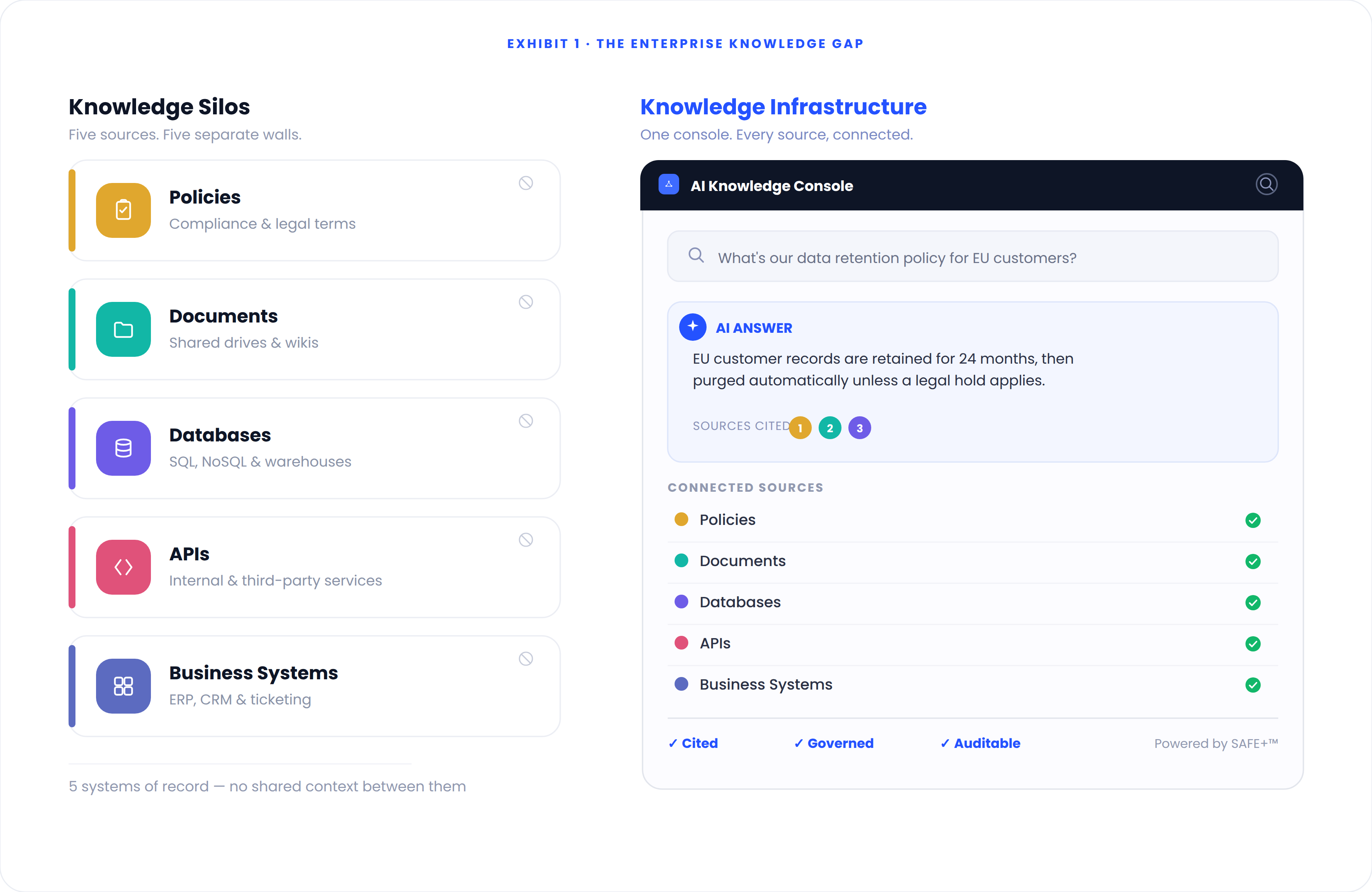
Every organization already possesses decades of valuable institutional knowledge. It exists across policies, documents, databases, business applications, APIs, operational systems, and the expertise of employees. The challenge is that this knowledge was never designed to function as a unified intelligence layer.
Humans compensate for fragmentation through experience. AI cannot. Without secure access to trusted enterprise knowledge, even the most advanced language model becomes another interface to disconnected information.
Enterprise AI isn't limited by model intelligence.
It's limited by knowledge infrastructure.
The missing layer in enterprise AI
Many organizations have invested heavily in AI applications while overlooking the infrastructure that makes those applications trustworthy. An enterprise chatbot can retrieve documents. An AI assistant can summarize reports. A language model can generate recommendations. But none of these capabilities answer the questions that matter most to enterprise leaders:

Is the information current?
Which policy takes precedence?
Who is authorized to see this answer?
Can this recommendation be audited?
Where did this response come from?
These are not model problems. They are knowledge infrastructure problems. Just as cloud computing required cloud infrastructure, enterprise AI requires a knowledge infrastructure that securely connects information, enforces governance, preserves context, and makes every response traceable. This is what we call a Sovereign Knowledge Layer.
A sovereign knowledge layer does not replace existing enterprise systems. It connects them through a secure intelligence layer, allowing AI to reason across enterprise knowledge while keeping data under organizational control.
From enterprise search to enterprise reasoning
For years, organizations have invested in making information easier to find. Enterprise search improved discoverability. Knowledge bases organized documentation. Content management systems centralized files. These technologies solved a retrieval problem. Enterprise AI introduces a reasoning problem.
Retrieval Era
- Finding information
- Keyword-based search
- Centralized repositories
- Limited governance
Reasoning Era
- Understanding relationships
- Permission-aware answers
- Evidence-backed responses
- Governed by design
Finding information is no longer enough. AI must understand relationships between policies, operational data, business rules, and institutional knowledge. It must generate answers that are accurate, explainable, permission-aware, and supported by evidence.
The future of enterprise AI is not defined by better search.
It is defined by better reasoning, and better reasoning begins with better knowledge infrastructure.
Five principles of trusted enterprise
knowledge infrastructure
Most discussions about enterprise AI focus on models. We believe organizations should begin somewhere else - by evaluating whether their knowledge infrastructure is ready for AI. Rather than measuring AI maturity through model performance alone, SAFE+™ evaluates whether enterprise knowledge is secure, trustworthy, and operationally ready for intelligent systems.
Bring AI to your knowledge, not your knowledge to AI
Enterprise knowledge should remain where it already exists. Organizations should not migrate millions of documents simply to enable AI. Instead, they should establish a secure intelligence layer that connects existing repositories while preserving ownership, security boundaries, and operational continuity.
Executive principle: Keep knowledge where it lives, and decide how it's used.
If an AI decision can't be audited, it can't be trusted
Every AI interaction should leave an evidence trail. Business leaders, compliance teams, and regulators should be able to answer who accessed the information, which sources informed the response, and which governance policies were applied.
Executive principle: Every interaction produces a traceable, accountable record.
Connect enterprise knowledge, don't consolidate it
Enterprise knowledge already exists; the objective is orchestration, not consolidation. A federated architecture securely connects policies, documents, databases, APIs, enterprise applications, and operational systems without creating another repository or duplicating data.
Executive principle: Connect everywhere, without creating new silos.
Every enterprise answer should explain itself
Enterprise AI should never operate as a black box. Every recommendation should include clear evidence, source citations, referenced policies, supporting evidence, and version history that enables users to understand and verify how it was generated.
Executive principle: Transparency turns an assistant into a trusted decision system.
AI should never know more than the person asking
Intelligence without governance creates risk. Enterprise AI must inherit existing security policies rather than bypass them, respecting role-based permissions, organizational controls, and regulatory requirements at every step.
Executive principle: Governance is what enables AI to operate safely inside the enterprise.
Why knowledge infrastructure matters more than model selection
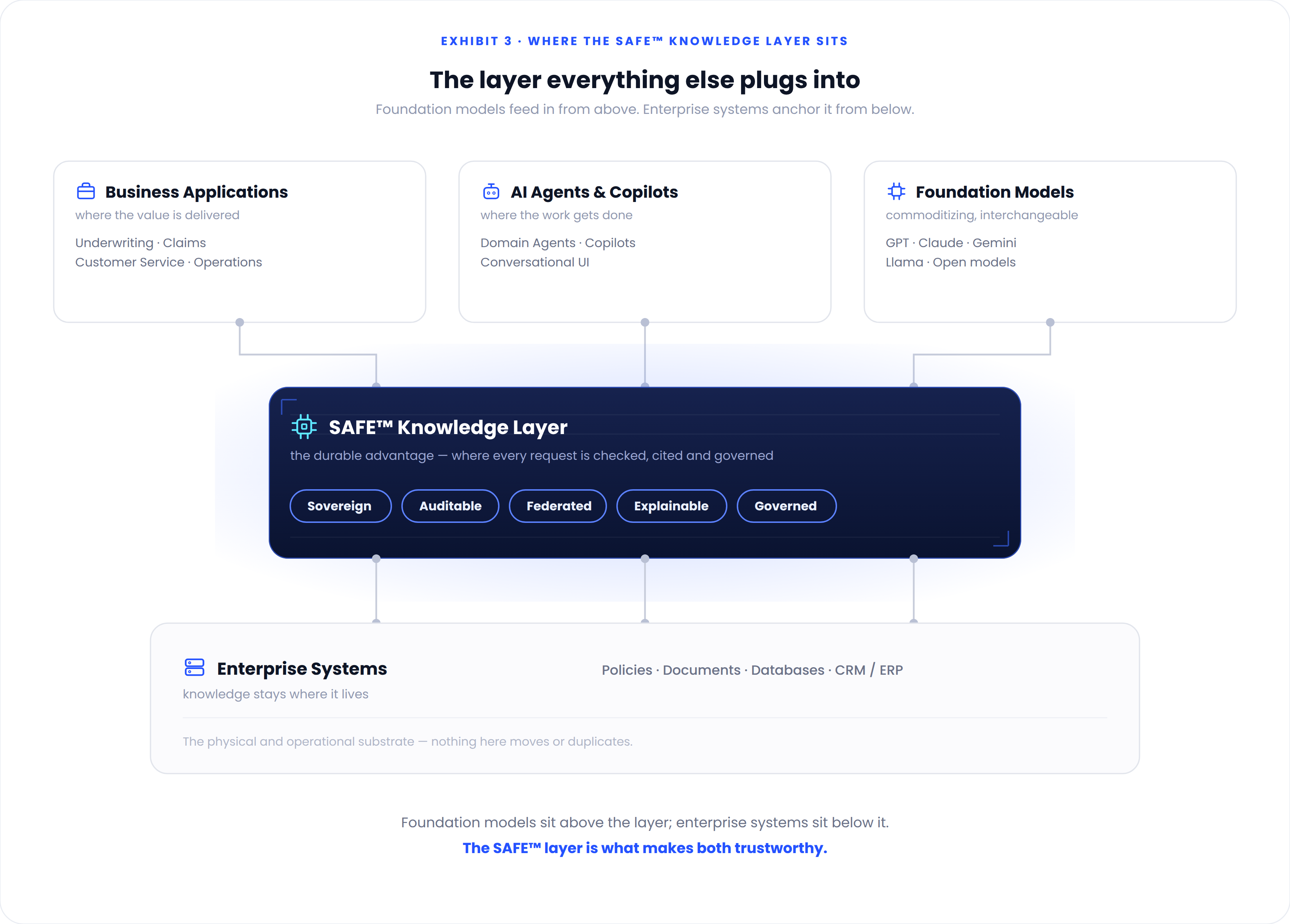
Language models are improving rapidly. Knowledge infrastructure does not improve automatically. A model can reason only with the information it receives, it cannot determine which policy is current, which regulation applies, or whether a user is authorized to access sensitive information. Those responsibilities belong to the enterprise.
As models become increasingly commoditized, competitive advantage will shift toward organizations that can deliver trusted, governed, and context-rich knowledge to those models.
The question for enterprise leaders is no longer “which model should we choose?”
It is: “is our knowledge infrastructure ready for AI?”
A new foundation for enterprise AI
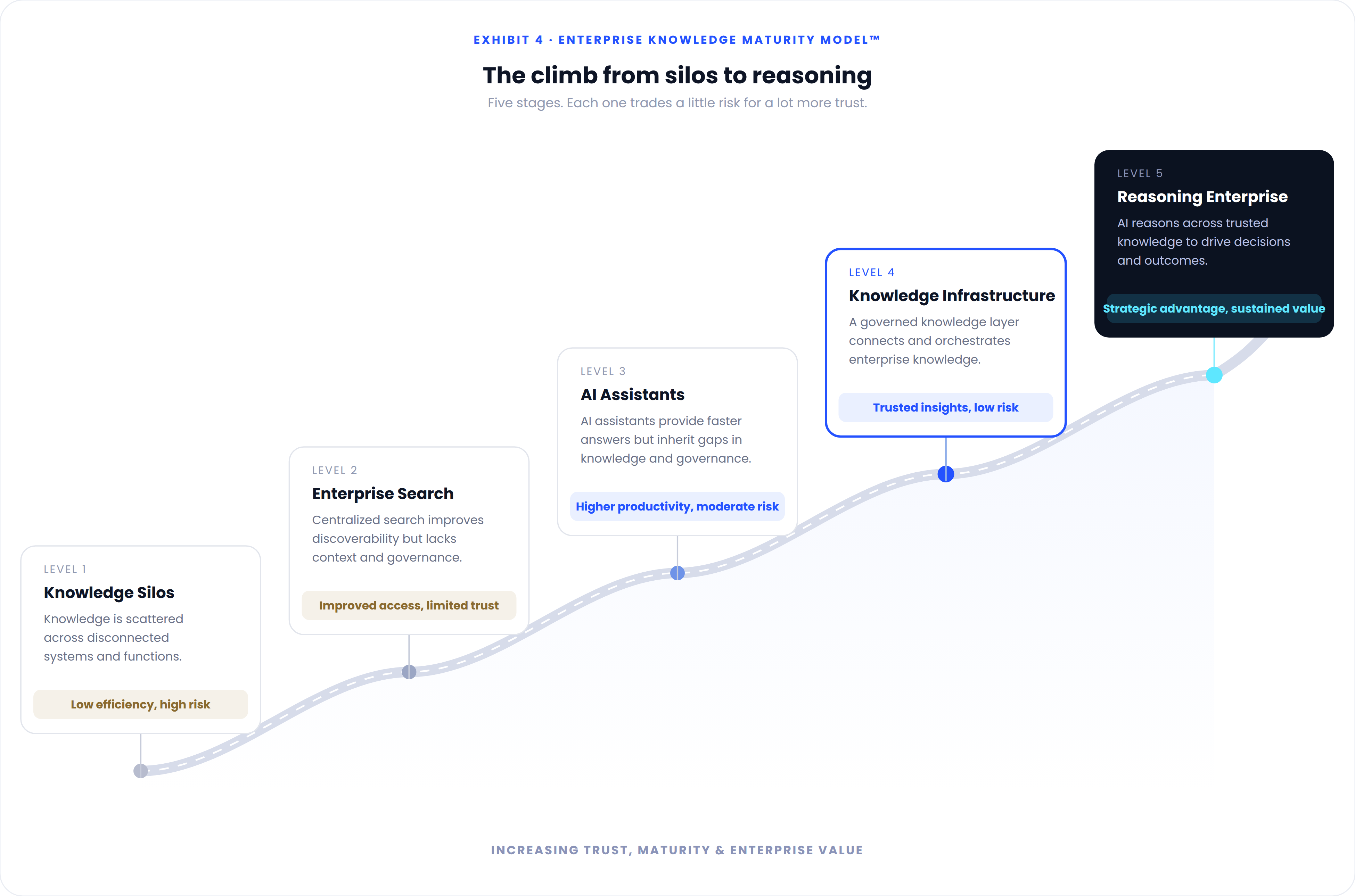
The first generation of enterprise AI focused on deploying intelligent models. The next generation will focus on building intelligent enterprises. That shift requires more than faster inference or larger context windows, it requires an architecture that connects enterprise knowledge securely, enforces governance consistently, and ensures every AI decision can be trusted.
Organizations that invest in sovereign knowledge infrastructure today will be better positioned to deploy AI across underwriting, compliance, operations, finance, customer service, and every other knowledge-intensive function tomorrow.
Conclusion
Enterprise AI is entering a new phase. The organizations that create lasting advantage will not be those with access to the latest models, but those that build the infrastructure those models depend on. A Sovereign Knowledge Layer provides that foundation by connecting enterprise knowledge without compromising governance, security, or control.
The SAFE+™ Framework offers a practical blueprint for evaluating enterprise readiness, ensuring knowledge remains Sovereign, intelligence is Auditable, connectivity is Federated, AI is Explainable, and access is Governed. As AI becomes embedded in every enterprise workflow, the most valuable asset will no longer be the model itself. It will be the trusted knowledge infrastructure behind it.
If every AI model became equally capable tomorrow,
would your enterprise still have a competitive advantage?
Is your knowledge infrastructure
ready for AI?
Aiden K implements the SAFE+™ Framework, a sovereign knowledge layer that connects enterprise knowledge securely while preserving governance and control.